
skip navigation
search

Bruce Thomas

Thomas R. Bruce is co-founder and director of the Legal Information Institute at the Cornell Law School, the first legal-information web site in the world. He was the author of the first Web browser for Microsoft Windows, and has been the principal technical architect for online legal resources ranging from fourteenth-century law texts to the current decisions of the United States Supreme Court. Mr. Bruce has consulted on Internet matters for numerous commercial, governmental, and academic organizations on four continents. He has been a fellow of the Center for Online Dispute Resolution at the University of Massachusetts, and a Senior International Fellow at the University of Melbourne Law School. He is an affiliated researcher in Cornell's program in Information Science, where he works closely with faculty and students who experiment with the application of advanced technologies to legal texts. He currently serves as a member of the ABA Administrative Law Section Special Committee on e-Rulemaking, on Cornell's Faculty Advisory Board for Information Technology, and is a longtime member of the board of directors of the Center for Computer-Assisted Legal Instruction. He has been known to play music at high volume.

supremeleft.jpgThe Supreme Court hears 5 cases this week; topics range from class-action suits to FOIA. As usual, our talented crew of LII Supreme Court Bulletin editors has analyzed the cases — just click on the casenames for a careful exploration of what they’re about:

Tuesday, January 18, 2011

Wednesday, January 19, 2011

supremeleft.jpgThis week, the Court hears cases on topics ranging from search and seizure to a water-rights dispute between three states.  Click on the case names for our analyses of the issues in each case.

Monday, January 10, 2011

 Tuesday, January 11, 2011

Wednesday, January 12, 2011

supremeleft.jpgThis week, the Supreme Court hears arguments in a wide variety of cases: veteran’s affairs,  Federal sentencing guidelines, employment discrimination, market timing, and consumer credit.  LII Supreme Court Bulletin analyses of the cases can be found by clicking on the  casename.

Monday, December 6, 2010

Tuesday, December 7, 2010

Wednesday, December 8, 2010

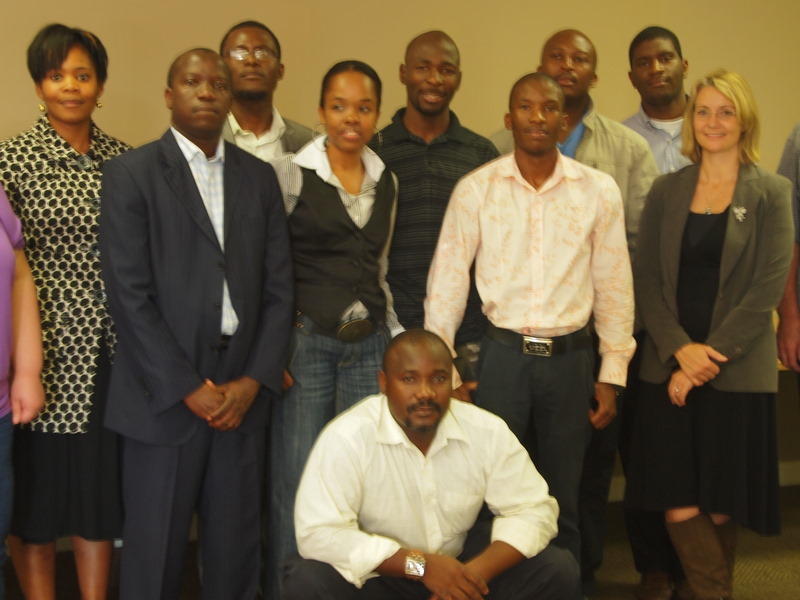
For the last three days, LII Director Tom Bruce has been meeting with representatives of seven African LIIs in Johannesburg (that’s right, “LII” is a global brand).  The workshop, sponsored by AfricanLII and the Open Society Institute of South Africa, was held to discuss new strategies for sustainability in open-access to law in southern Africa.  Participants came from Kenya, Malawi, Mozambique, Namibia, South Africa, and Swaziland.

Sustainability is a sort of code word:  the idea that open-access providers need to find ways to pay their bills so that they can remain viable over the long term.  Free access to law is never costless, and LIIs in the developed and developing worlds alike need to find innovative ways to meet their expenses.  There are many ways to do that — some entrepreneurial, some philanthropic — and a number of novel, interesting and surprising ideas were put forward by energetic workshop participants.

The best thing to come out of the three-day workshop?  The slogan for SwaziLII is “kwetfu”, a  Swazi word that means “it is ours”. It’s the best thing anyone could say about their law — and something we work toward every day.

This week, SCOTUS hears cases on first sale doctrine, medical residents, and railroads among others.  You can read the LII Supreme Court Bulletin analyses of each by clicking on the links:

Monday, November 8, 2010

Tuesday, November 9, 2010

Wednesday, November 10, 2010

Nov 012010

This week, the Supreme Court hears arguments in a wide range of cases.  As always, the LII’s Supreme Court Bulletin provides thoughtful analysis of the upcoming cases. Just click on the links below to read all about them:

Monday, November 1, 2010

Tuesday, November 2, 2010

Wednesday, November 3, 2010

Last Thursday, LII Director Tom Bruce gave the inaugural talk in a series of workshops on legal information hosted by the University of Montreal’s CRDP.  Invited (and on occasion provoked) by old LII friend Daniel Poulin (pictured here), the founder of the LexUM legal-informatics research group and of CanLII,  Bruce spoke about the initial vision for open access to legal information, its flaws, and the realities of the present day. The general challenge now, he said, is similar to that posed by behavioral economics.  Our formal notions about how legal information is generated, structured, and searched are useful so far as they go, but in some respects fail to take note of what it is that people actually do.  This poses important challenges for our thinking about legal research in general,  and document modelling in particular.

On Monday evening, Sara Frug and Tom Bruce gave a sneak preview of a new LII product for a small audience at the Federal Depository Library Council October meeting in Washington DC.  Luminaries in attendance included Michael Wash, CIO of the US Government Printing Office; Michael White, Managing Editor of the Federal Register, and Mary Alice Baish of the AALL along with many interested govdocs librarians and LII friends.  What were they showing?  Well, we could whisper something about the Code of Federal Regulations, but then you’d just want to know when it will be available to the public (our best answer:  Real Soon).

Work on this project has been undertaken as part of an ongoing agreement with the Federal Depository Library Program, who have been kind enough to make data available to us in exchange for expertise.  The project is the first we’ve undertaken that builds on the new FD/SYS initiative. We are very excited to be working with FDLP and GPO on a project that involves the largest contact surface between the American public and Federal law.

The LII’s guest-blog for the legal informatics community, VoxPopuLII, has an interesting piece by Joao Lima.  Lima heads the team that has built LexML Brazil, an integrated portal for legislation and law from many Brazilian jurisdictions.  An ambitious project aimed at achieving semantic interoperability across numerous federated collections of law, LexML Brazil is a state-of-the-art illustration of what can be done when the legal-information community takes advantage of the latest techniques from the digital-library and information science communities.  We recommend it highly.  The article also contains a list of related systems-building articles published in VoxPop over the last year, a virtual Who’s Who of legal-information systems builders.

LII Director Tom Bruce is giving a talk about law.gov today at the National Association of Bar Executives Communications Workshop in Portland, Maine.  Tom’s appearing with LII BFF Ed Walters, CEO of FastCase.  We think it’s important that those who communicate and market on behalf of lawyers understand what law.gov is, and what it’s going to mean to the legal profession.  One hint:  it’s more than just “free legal information stuff”… think WebMD, and what an informed clientele might mean to lawyers generally.  Time will tell, of course, but we think that mass availability of law is going to change interaction between the public and the profession for their mutual benefit.