
 HeinOnline has become indispensable for law review articles, as well as pdfs of the US Code, CFR, Federal Register, U.S. Reports, English Reports, and much more. They have recently announced a free app for your iPhone or iPad. Click here for more details, including how the app works with our IP authentication access. Features of the app include the citation navigator, browsing by volume, and the electronic table of contents.
 The online resource Getting the Deal Through provides summaries of the laws of many countries on business-related topics (called “Practice Areas”) such as banking regulation, the environment, shipping, mergers & acquisitions, and product liability. The summaries, which are written by practicing attorneys throughout the world, are organized in a Q&A format. Getting the Deal Through has summaries for more than 40 practice areas and 100 jurisdictions, although not every jurisdiction is covered for each practice area. Material is up to date within the past year or so. Summaries for a practice area/jurisdiction (e.g. banking regulation in Argentina) can be downloaded in PDF. You can create a custom report by selecting only the countries and questions that interest you. To get to the database, do a title search in the Cornell Library catalog for “Getting the Deal Through” OR use the link on the Law Library’s Online Legal Resources page for Corporate & Securities.
Oct 032011
This week you received a Bloomberg Law password via email. What is Bloomberg Law? It is a database that allows you to search for primary law, as well as news and company information. One of the major benefits from using B-Law is that you can keep your password and continue to use it over the summer. Our Bloomberg Law rep is Pamela Haahr. She will be here on Wednesday and Thursday, Oct. 5th and 6th, to distribute information and answer your questions about this service. She will be set up at the table outside the Reading Room (in the 3rd floor stacks area) from 10am to 5pm. Feel free to stop by and get a short demo of this alternative to Lexis and Westlaw.
Sep 122011
 The Law library is hosting an open house for all students on Tuesday, September 20, 2011, 11:00am-1:00pm, in the Gould Reading Room. Library resources and services will be featured at stations throughout the room, including:
• An introduction to “hidden” online databases;
• Information regarding personalized research consultations;
• An overview of upper level research classes;
• Our open access repository of Cornell student and faculty scholarship;
• Demonstrations of our library catalog and interlibrary loan services;
• A rare book display;
• And more.
Students who visit every station will receive a library pen and be entered in a grand prize drawing to win their choice of two round trip Campus-to-Campus bus tickets to New York City, or a limousine wine tour for 2-4 people. Other prize drawings will feature $25 gift certificates to local businesses including Gimme! Coffee, Cinemapolis, and Purity Ice Cream. Drawings will occur at 1pm; students need not be present to win.
A book sale will be held simultaneously with the open house. All books will be available for $1 at the East end of the Reading Room.
Join us for some quick, informative fun and snag a seasonal snack from Cornell Orchards!
Competition is thriving in the online legal information market. And perhaps the most successful of the new players is Bloomberg Law, or B-law, outgrowth, of course, from the wildly successful Bloomberg financial news and data service. They describe their edge as “the first real-time legal research system that integrates innovative search technology, comprehensive legal content, company and client information, and proprietary news all in one place.”
Bloomberg Law has a new web interface to which Cornell Law School users will be introduced on Wednesday, July 13, at 10:30am, in room 273. This update session will be conducted by our Bloomberg Law representative, Pamela Haar. Please join us if you are interested in this up and coming competitor to Lexis and Westlaw.
 Bloomberg Law passwords will be available on Monday, April 4 in alcove 43 of the Reading Room between 11 a.m. and 5 p.m. Stop by to meet our Bloomberg representative and get your password for access to up-to-date business, news and law reports.
 The webinars on HeinOnline Searching have been rescheduled for this week on Thursday, March 3, at 10am & 2pm.
It’s not too late; you can still register for one of these sessions:
- Sign up for 10am at https://www2.gotomeeting.com/register/122053890
- Sign up for 2pm at https://www2.gotomeeting.com/register/619093115
For more information about the webinar, click here.
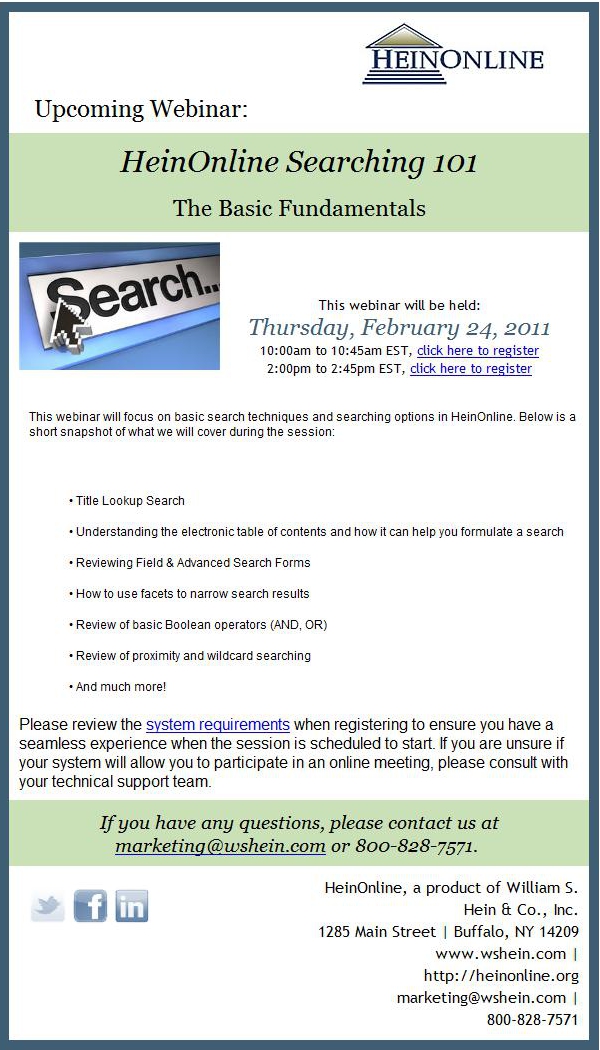
HeinOnline has earned its place as a comprehensive legal research tool. You probably use it for finding pdfs of journal articles when you have the citation. Over the last few years, it has developed its searching capabilities to be a first choice for searching journal articles. Hein is offering a 45-minute webinar on Thursday, February 24 at 10:00 am and at 2:00 pm on search techniques for HeinOnline. Sign up using the links below, and you can learn – right at your desktop — more strategies for improving your searches. To register for the 10:00 am session, click here. For the 2:00 pm session, click here.
If you are a 2L or a 3L and want to have access to one of the premier databases for company information and news, in addition to legal information, stop by Alcove 43 in the Reading Room on Monday, Feb. 7 and meet with our Bloomberg representative. Pamela Haahr will be handing out passwords and providing individual instruction on how to use Bloomberg Law. 2Ls will be able to take Bloomberg Law with them to their summer employment because their passwords will remain active over the summer, unlike Lexis and Westlaw passwords. Pamela will also have “give-aways” for interested students.
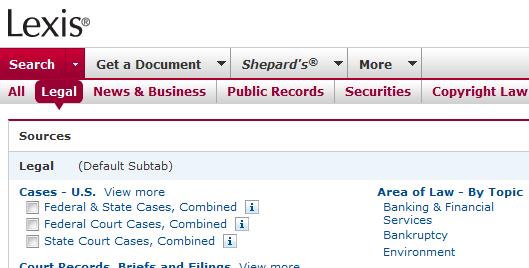 If you have signed on to Lexis recently, you’ve likely noticed a new look. Like Westlaw, Lexis is currently in a period of change. Later this year, Lexis will roll out a new platform to compete with WestlawNext. But recently, Lexis has adjusted the interface of their current platform to make it more user-friendly and eye-appealing. The interface uses crisper lines, fewer colors, and even more white space than the previous interface. A change that many will appreciate is the reduction in the number of tabs running along the top of the page. The most important tabs—Search, Get a Document, and Shepard’s—still appear; however, the many other available features are now tucked under a tab labeled “More.” This is a great improvement.
Both the Recently Used Sources and Search by Topic or Headnote features have been moved to the right side in their own boxes. This change achieves the dual goal of reducing clutter while making these features more prominent. Also on the right side one sees Quick Tools, which allows users to quickly pull up documents, Shepardize, locate a source, or use the Lexis web with a single search box. The right side also includes an Emerging Issues section highlighting articles posted by practitioners in an array of practice areas. Overall, the changes Lexis has made are for the better. In time, we will see what their answer is to WestlawNext.


