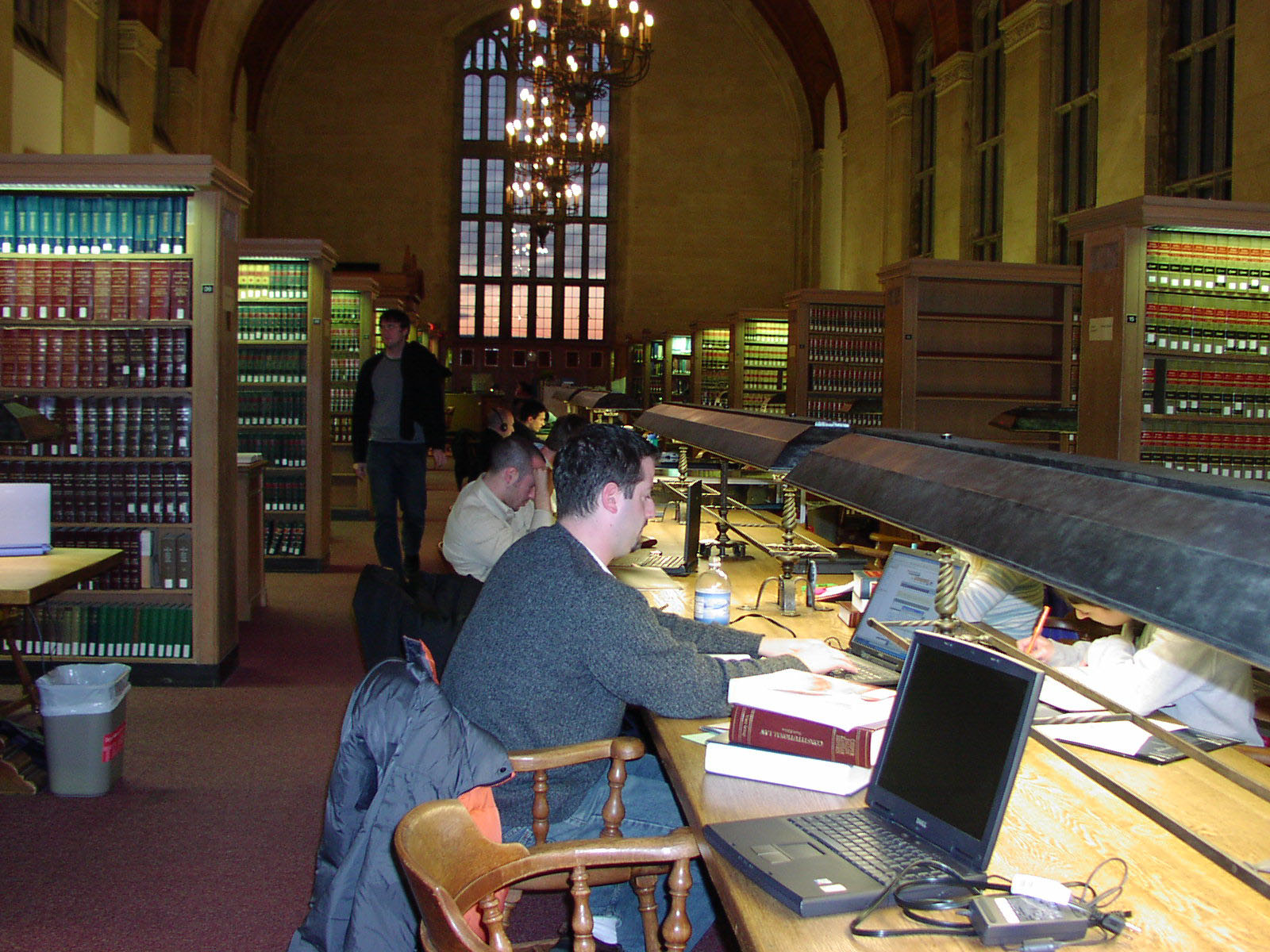
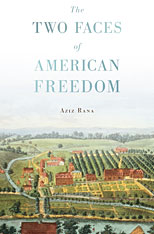
Rana book coverIn honor of Professor Aziz Rana‘s new book The Two Faces of American Freedom, today Cornell Law School hosted a celebration featuring remarks from Nancy Rosenblum, the Senator Joseph Clark Professor of Ethics in Politics and Government at Harvard University, William Forbath, the Lloyd M. Bentsen Chair in Law at the University of Texas at Austin School of Law, and Richard Bensel, Associate Chair and Professor in Cornell University’s Department of Government.  The book is also being featured at the Law Library circulation desk in the Reading Room.

Professor Rana’s book, which grew out of his dissertation work at Harvard, argues that in the United States, freedom and exclusion were not competing values, but part of the same ideological system.  Those in power maintained their economic and social freedom by denying those same freedoms to others (e.g., Indians and African Americans).  This practice continues today; interest groups (for example, the Tea Party movement and labor unions) advocate for policies to protect their economic well-being and against policies that will extend privileges and benefits to others, fearing their own economic and political positions will diminish.  The book’s concluding argument is that political change and the preservation and extension of freedom has continuously been the result of groups of people, most often the marginalized, unifying their voices in support of freedom.  For these and other insights, presented in beautifully written prose, take a look at the book.

Computer mouseOur own Professor Bob Hillman and his collaborator Professor Maureen O’Rourke of the Boston University School of Law have a forthcoming article on the law of software contracts, which is available on SSRN’s Legal Scholarship Network (LSN).  Professors Hillman and O’Rourke are not new to the topic: they are the Reporter and Associate Reporter for the American Law Institute’s (ALI) Principles of the Law of Software Contracts.  The Principles have been years in the making with a discussion draft submitted to the ALI back in 2007.  ALI membership unanimously approved the final draft in May 2009.  The current law of software contracts is a messy patchwork drawing from federal intellectual property law, common law, and Article 2 of the Uniform Commercial Code.  Thus, the Principles project seeks to “clarify and unify the law of software transactions” by addressing issues of contract formation, enforcement of terms, automated disablement, and contract interpretation, among other issues.

Now, while software and software law may seem mundane in today’s digitally-driven world, the Principles have not been without controversy, especially in the areas of indemnification and warranties.  Specifically, section 3.05, “Other Implied Quality Warranties,” has garnered attention.  The section creates a non-excludable implied warranty that “the software contains no material hidden defects of which the transferor was aware at the time of the transfer.”  Software providers have expressed concern over the phrase “material hidden defects” and the meanings of the individual words.  There is a fear that litigation against them will increase.  Professor Hillman addresses the issue of section 3.05 in a thorough blog post last summer.  It is worth a read and there are several comments that readers should consider, too.  They highlight the notion that exciting controversy is not just the domain of constitutional law cases at the Supreme Court!

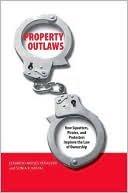
Property Outlaws book coverCornell Law School is celebrating the publication of Prof. Eduardo Peñalver’s book Property Outlaws: How Squatters, Pirates, and Protesters Improve the Law of Ownership, which he co-authored with Sonia K. Katyal, Professor at Fordham University School of Law.  The library catalog information for the book is available here. You can see the Table of Contents and read selected pages from the book at amazon.com.

If you are intrigued by the concept of the role of the lawbreaker as a force in the evolution of property law, you can read an earlier treatment of the topic entitled “Property Outlaws,” co-authored by Professors Peñalver and Katyal in 155 U. PA. L. REV. 1095 (2007) and available in Scholarship@Cornell Law.  The book expands the scope of the earlier article and also introduces the concept of “Altlaws.”  Altlaws appear to violate the laws of intellectual property but “skirt the boundaries of property legality and can often make an objectively plausible argument that, although in a sense they are rebelling against the property status quo, their conduct actually falls within the boundaries of legal permissibility.”  Altlaws push against the unclear boundaries of intellectual property law, as opposed to Outlaws who clearly operate outside the boundaries of property law.

For more of Professor Peñalver’s writings, see his faculty publications page and the Scholarship@Cornell Law online repository.

In “The Torture Lawyers” published at 51 Harv. Int’l L.J. 193 (2010) and available in Scholarship@Cornell Law, Cornell Law Professor Jens Ohlin examines the use of the justified necessity and excused necessity defenses by government agents who engaged in acts of what many consider to be torture during the Bush Administration. Professor Ohlin then discusses why Bush Administration attorneys who advocated the use of torture and may be considered accomplices in torture cannot successfully use these same defenses under the “flow-down” theory. To counter the objection that attorneys cannot be prosecuted simply for giving advice, Professor Ohlin examines two cases from the Nuremberg trials:

  • Prosecutor v. Altstoetter et al. (the Justice Case), in which members of the German Justice Ministry were charged with giving legal effect to Nazi statutes and decrees that stripped the right to due process of law from many groups and individuals throughout Germany and German-controlled territories.
  • United States v. von Weizsaecker et al. (the Ministries Case), in which members of Nazi ministries, including the Foreign Policy Office, were charged with war crimes stemming from their advisement of Nazi leaders regarding the deportation of Jews to concentration camps and other actions.

For other work by Professor Ohlin, see his faculty publications page. I recommend the following:


Cynthia Bowman Unmarried Couples, Law, & Public PolicyIn honor of Cornell Law School Professor Cynthia Grant Bowman‘s new book, Unmarried Couples, Law, and Public Policy, today we are highlighting a few of her other publications. In addition to a degree in law, Professor Bowman earned a Ph.D in political science, and she brings an interdisciplinary approach to her analysis of topics such as family law and feminist jurisprudence.

Professor Bowman studied the relationship between law and cohabitation–and especially its impact on low-income women–for many years before writing this book:

For more of Professor Bowman’s writings, see her faculty publications page and the Scholarship@Cornell Law online repository.

Professor lecturing at podiumThe Law Library developed Scholarship@Cornell Law (S@CL) to provide an online repository for faculty publications and working papers. S@CL has expanded and now includes many other interesting collections to explore. So here are three reasons to click on the link on the Law Library home page to visit S@CL:

  1. Did I mention faculty scholarship? You can browse through papers submitted by year or search by author and see just what your professors have been up to. The collection includes published articles and working papers.
  2. Check out the Centers and Programs link. Find out about ongoing programs like the Death Penalty Project and the Avon Global Center for Women and Justice (just click on International Comparative Programs to find the Avon Global Center).
  3. Conferences, Lectures and Workshops gives you a chance to “attend” some of the interesting programs that have been held in the law school in years past. This collection lets you see what was discussed in the comfort of your own room.

We have other collections worth visiting, but hopefully these three highlights will pique your interest in the scholarship happening at Cornell Law School.

© 2013 InfoBrief Suffusion theme by Sayontan Sinha