
 If you are a 2L or a 3L and want to have access to one of the premier databases for company information and news, in addition to legal information, stop by Alcove 43 in the Reading Room on Monday, Feb. 7 and meet with our Bloomberg representative. Pamela Haahr will be handing out passwords and providing individual instruction on how to use Bloomberg Law. 2Ls will be able to take Bloomberg Law with them to their summer employment because their passwords will remain active over the summer, unlike Lexis and Westlaw passwords. Pamela will also have “give-aways” for interested students.
CISER, the Cornell Institute for Social and Economic Research, offers free workshops in statistical research methods each semester. Some of the available workshops include how to use statistical software like Stata and SPSS (separate classes) and accessing restricted social science data at Cornell. View the schedule and sign-up here.
Jan 282011
 The Law Library has recently subscribed to the electronic version of the Max Planck Encyclopedia of Public International Law (MPEPIL). The Max Planck Institute for Comparative Public and International Law, located in Heidelberg, Germany, is one of the foremost research centers for international law. The Max Planck Encyclopedia, first published in paper between 1991 and 2001, is an essential resource for researching international law. Now in an electronic format published by Oxford University Press, the MPEPIL offers a comprehensive, searchable database of frequently updated and new articles by highly regarded scholars from around the world. Articles within the MPEPIL are fully cross referenced and linked to other articles in the database. There are also links to other Oxford University Press databases to which the Law Library subscribes:
- Oxford Reports – International Law in Domestic Courts (ORIL)
- Oceana Treaties and International Agreements Online (TIAO)
Access is by IP address, so you can access MPEPIL from any computer in the Law School or from http://uportal.cornell.edu.
Another recommended Oxford encyclopedia relating to international law is the Encyclopedia of Human Rights, also available online.
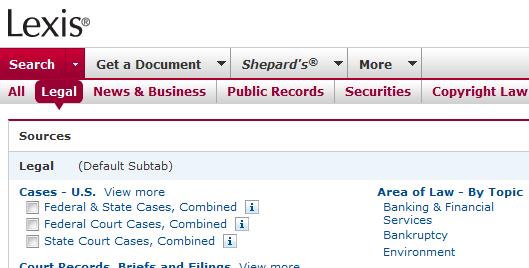 If you have signed on to Lexis recently, you’ve likely noticed a new look. Like Westlaw, Lexis is currently in a period of change. Later this year, Lexis will roll out a new platform to compete with WestlawNext. But recently, Lexis has adjusted the interface of their current platform to make it more user-friendly and eye-appealing. The interface uses crisper lines, fewer colors, and even more white space than the previous interface. A change that many will appreciate is the reduction in the number of tabs running along the top of the page. The most important tabs—Search, Get a Document, and Shepard’s—still appear; however, the many other available features are now tucked under a tab labeled “More.” This is a great improvement.
Both the Recently Used Sources and Search by Topic or Headnote features have been moved to the right side in their own boxes. This change achieves the dual goal of reducing clutter while making these features more prominent. Also on the right side one sees Quick Tools, which allows users to quickly pull up documents, Shepardize, locate a source, or use the Lexis web with a single search box. The right side also includes an Emerging Issues section highlighting articles posted by practitioners in an array of practice areas. Overall, the changes Lexis has made are for the better. In time, we will see what their answer is to WestlawNext.
The Legal History and Rare Books Section (LH&RB) of the American Association of Law Libraries, in cooperation with Cengage Learning, announces the third annual Morris L. Cohen Student Essay Competition. Students currently enrolled in accredited graduate programs in law, library science, history, or related fields are eligible to enter the competition. Essays may be on any topic related to legal history, rare law books, or legal archives. The entry form and instructions are available at the LH&RB website: http://www.aallnet.org/sis/lhrb/. Entries must be submitted by March 15, 2011. The winner will be announced by April 15.
The winner will receive a $500.00 prize from Cengage Learning and up to $1,000 for expenses associated with attendance at the AALL Annual Meeting in Philadelphia in July 2011. The runner-up will have the opportunity to publish the second-place essay in LH&RB’s online scholarly journal Unbound: An Annual Review of Legal History and Rare Books. Please direct questions to Robert Mead at libram@nmcourts.gov or Sarah Yates at yates006@tc.umn.edu.
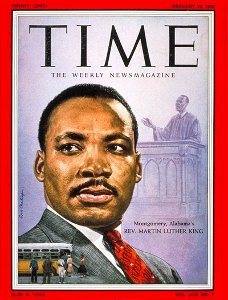 In honor of Martin Luther King, Jr. Day yesterday, I’m posting the link to Time magazine’s archive of articles and covers about the civil rights leader. The early articles’ text captures the anger of those tumultuous times, both of blacks and of whites. Then compare those articles with the Time 100 retrospective of King, published in 1998.
For more about King:
- More than a dreamer: Remembering Dr. Martin Luther King, Jr. Monroe H. Little, Jr. 41 Indiana Law Review 523 (2008).
- Civil rights, immigrants’ rights, human rights: Lessons from the life and works of Dr. Martin Luther King, Jr. Jennifer M. Chacón. 32 New York University Review of Law and Social Change 465 (2008).
- Dr. King and Parents Involved: The battle for hearts and minds. Wendy B. Scott. 32 New York University Review of Law and Social Change 543 (2008).
- The radical King: Perspectives of one born in the shadow of a king. Camille A. Nelson. 32 New York University Review of Law and Social Change 485 (2008).
- Surveillance and identity performance: Some thoughts inspired by Martin Luther King. Frank Rudy Cooper. 32 New York University Review of Law and Social Change 517 (2008).
Jim Bishop, 2L, has won an iPad from BNA! He registered to receive BNA updates, along with thousands of other law students across the country. And Jim was the winner!
If you want to receive BNA updates from US Law Week or on topics from banking to tax, labor law to mergers and acquisitions – go to http://library2.lawschool.cornell.edu/bna/subj/ and sign up for your choice of e-mail summaries.
The Pew Research Center’s Global Attitudes Project recently released a report showing that computer and cell phone usage have increased significantly throughout the world, especially in certain countries such as Russia and Argentina. The report also looks at the use of social media and email, and analyzes technology usage by age group and gender. The full report is available here.
Law firms take their holiday cards very seriously–after all, they are marketing tools–but not so seriously that they can’t be fun. Here are some notable cards from the last few years, organized by theme (note: these cards have background music):
- The legal-disclaimer-is-funny theme. In 2008 Pillsbury Winthrop made sure the card’s recipients were fully apprised of the dangers of snowballs. This year the Wall Street Journal Law Blog declared Manatt, Phelps & Phillips’s card to be the best of the 2010 season. Manatt’s card takes a meta approach, humorizing the card design process. The disclaimer in Manatt’s card is very similar to those used in Akin Gump’s 2009 card, which won Above the Law’s 2009 holiday card contest.
- The do-gooders theme. Howard Rice donated the savings from skipping the paper card in 2009 to charity, inviting the recipients of its electronic card to select the charity. Dickstein Shapiro sponsors an art contest every year at a public high school in Washington D.C. and features the winning artwork on its holiday card. In 2007, Stearns Weaver thanked clients for making this really large gift possible.
- The solidarity-with-clients theme. Grodsky & Olecki represented some members of the Writers’ Guide during the strike in 2007 and reflected that representation in their card. I would like to see this theme used more often.
Is it just me, or do almost all of these cards feature music written by the same person?
Happy holidays, and please–wear your Snuggie properly.
Have you ever been conducting Internet research, ventured into the reader comments that accompanied a perfectly ordinary article or blog, and been shocked at the level of incivility exhibited by some readers? I’m not referring to pointless, silly, off-topic, dissenting comments (or the ever-present spam), but rather the kind of comments that make you cringe and suddenly regret wasting your time by spending it in the company of so much litter. Such comments are especially jarring when embedded in an otherwise engaging and generally thoughtful discussion. Some readers, apparently empowered by anonymity and with too much time on their hands, feel compelled to use online comments to vent their innermost hatred for, well, pretty much anything. It’s not new, but it is a disappointing trend that detracts from what otherwise serves as a productive forum for sharing information and opinions; one that is often helpful to researchers. As a result, many online publications have stopped allowing comments, appointed moderators, or now require readers to register before posting comments. Despite all the noise, I still value the occasional comment that leads to a great resource or an elusive answer. The rest just keeps boredom at bay.


